
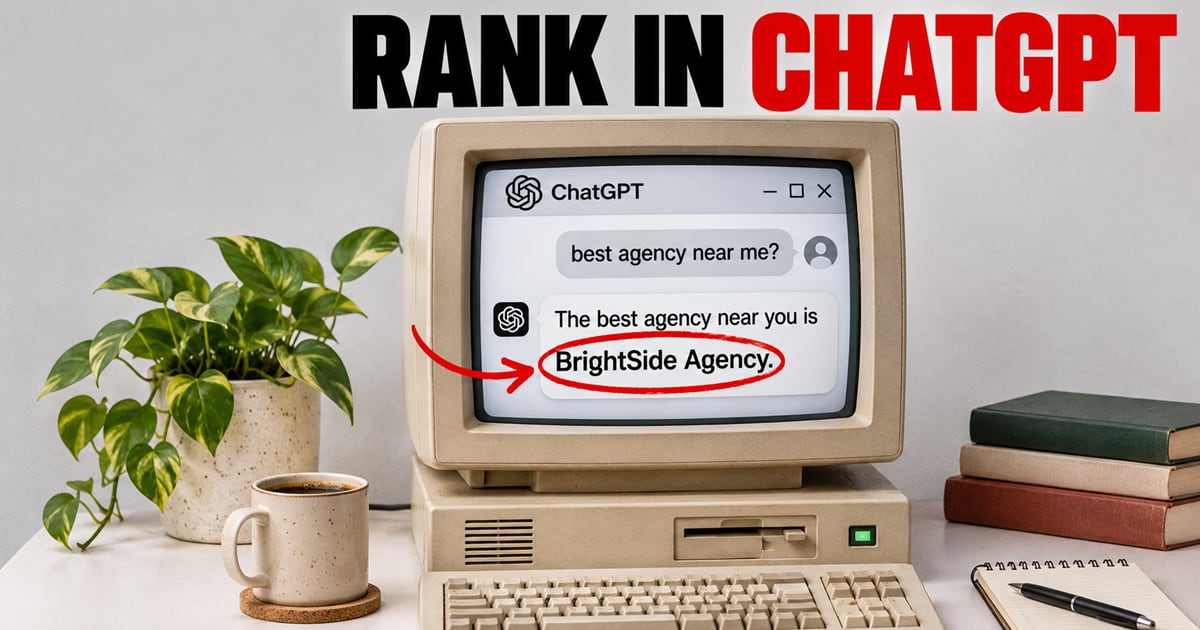
Here's the 10-step checklist we use.
First: how ChatGPT chooses which businesses to name
When ChatGPT searches the web for an answer, it pulls pages that match the question, then favours passages that answer it clearly and come from sources that agree with each other. When it answers from memory, it relies on what it learned in training, which mostly reflects how often and how consistently your business is described across the web.
So there are two jobs:
- Make your own pages the clearest answer available.
- Get independent, trusted sites to confirm the same facts.
The 10-step checklist
1. Let AI crawlers into your site. Check that your robots.txt doesn't block GPTBot and OAI-SearchBot (OpenAI), ClaudeBot (Anthropic), PerplexityBot or Google-Extended. Check your CDN too. Some Cloudflare settings block AI bots by default, even when robots.txt allows them.
2. Make sure your pages work without JavaScript. Many AI crawlers read only the HTML your server sends, not what JavaScript builds afterwards. If your text only appears after scripts run, the crawler may see an empty page. Pre-rendering or server-side rendering fixes this.
3. Write one clear page per service. A single "Services" page listing ten things gives an AI nothing specific to quote. Give each service its own page with a clear heading such as "WhatsApp chatbot for real estate agencies in Dubai".
4. Put the answer first. Start each page and each section with a 40 to 60 word answer that makes sense on its own. AI tools lift passages like this almost word for word. Put the detail underneath.
5. Use question headings. Write headings the way buyers ask: "How much does a Shopify store cost?" rather than "Pricing". Questions match the prompts people type into ChatGPT.
6. Add specific facts only you can provide. Real prices, timelines, processes, locations and results. A line like "Clinic websites from $X, live in 3 weeks, built for UAE patients" is far more quotable than "We are a leading agency". Generic copy gives AI no reason to pick you.
7. Add structured data. Use schema markup (Organization, Service, FAQPage, Person for authors) so machines read the same facts people do. Keep it accurate: wrong structured data is worse than none.
8. Keep your business facts identical everywhere. Your name, description, services, location and founders should read the same on your website, LinkedIn, Google Business Profile, Clutch, Crunchbase and directories. Mixed messages make AI less confident about who you are.
9. Earn mentions on sites AI already trusts. Answer journalist requests, collect genuine reviews on Clutch or Trustpilot, publish original data others can cite, and write helpful answers on Reddit and LinkedIn. These independent sources confirm your claims.
10. Track it with a fixed list of prompts. Write down 20 to 40 questions your buyers would ask, such as "best AI SEO agency for small businesses". Each month, ask ChatGPT, Gemini and Perplexity and record whether you're mentioned, linked, or missing. Answers vary between runs, so watch the trend, not one screenshot.
Bonus: add an llms.txt file
llms.txt is a plain-text file at the root of your site that lists your most important pages with a one-line summary each. Not every AI tool reads it yet, but it costs nothing and gives assistants a clean map of your site.
What doesn't work
- Mass-produced AI blog posts. They repeat what's already online, so AI has no reason to cite you, and they can hurt your Google rankings.
- Stuffing "best agency" into every page. AI tools look for evidence, not adjectives.
- Fake reviews or fake listings. They break platform rules and destroy trust when found.
- Expecting overnight results. Assistants that search live can pick up changes within weeks. Answers from training data change only when models are updated.
How long does it take to rank in ChatGPT?
- Crawler access and structured data fixes: 1 to 2 weeks.
- Rewritten pages showing in live-search answers (ChatGPT search, Perplexity): a few weeks after Google and Bing index them.
- Answers from the model's memory: months, tied to model updates.
Is ranking in ChatGPT different from ranking on Google?
Yes, but the two help each other. Google rewards the best page in a list of ten. ChatGPT often names only three to five companies, so you need to be the clearest, best-supported answer. The foundations are the same: a fast, crawlable site, clear pages and genuine authority. That's why we run classic SEO and AI search work together.
Want to know where you stand in AI search? Alphenex runs prompt audits across ChatGPT, Gemini and Perplexity for businesses in the USA, UK and UAE. See our AI SEO service, or book a free 15-minute call.

 November 24, 2026Google Ads vs Meta Ads in 2027: Which Should Your Business Use?
 November 24, 2026Shopify Website Cost in 2027: Standard vs Custom vs Headless