
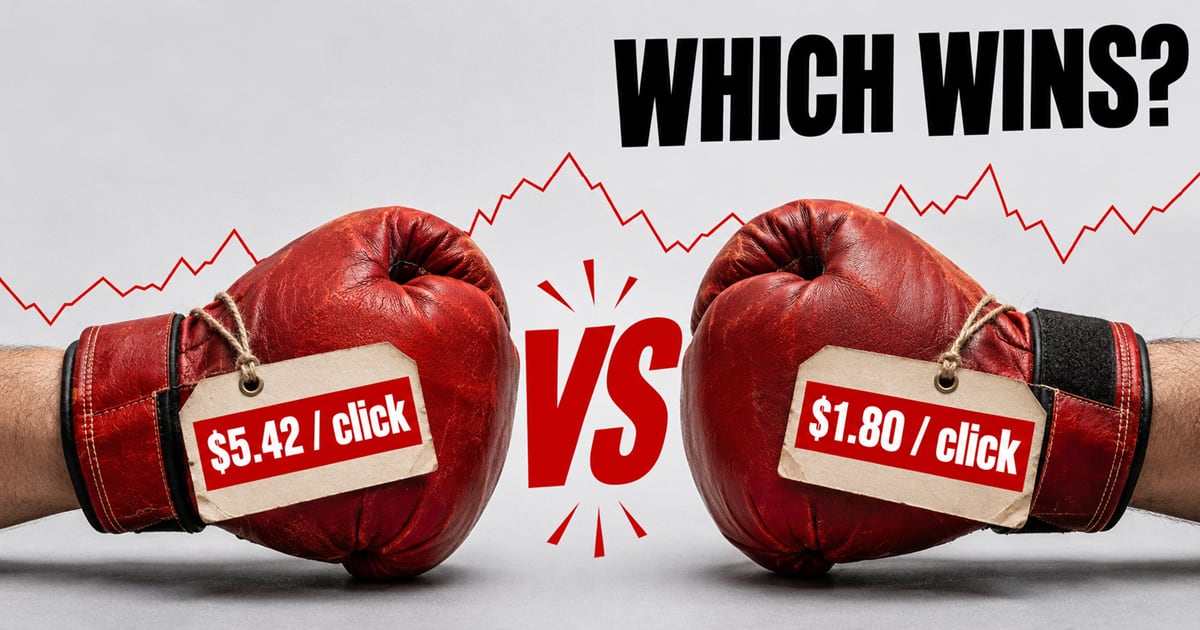
Below is a full side-by-side comparison with 2026 benchmark data, a simple way to decide, and how to split your budget.
Google Ads vs Meta Ads at a glance
| Google Ads | Meta Ads (Facebook + Instagram) | |
|---|---|---|
| How people find you | They search for it ("emergency plumber near me") | You appear in their feed while they scroll |
| Buyer intent | High: they're actively looking | Lower: you interrupt them |
| Average cost per click | $5.42 | $1.80 (lead campaigns), $0.60 (traffic campaigns) |
| Average conversion rate | 8.18% | 8.54% (lead campaigns) |
| Average cost per lead | $66.69 | $27.39 |
| Best for | Services people search for, urgent needs, B2B, high-ticket offers | Visual products, e-commerce, new ideas, local offers, retargeting |
| Ad formats | Text search ads, Shopping, YouTube, Display, Performance Max | Images, Reels, carousels, Stories, instant lead forms |
| Targeting | Keywords and search intent | Interests, demographics, lookalikes, behaviour |
| Speed to first leads | Fast, if search demand exists | Fast, but creative testing takes 1 to 3 weeks |
| Biggest risk | Expensive clicks on broad keywords | Cheap leads that never answer the phone |
Benchmarks: WordStream/LocaliQ 2026 Google Ads benchmarks (April 2025, March 2026, all industries) and WordStream 2026 Facebook Ads benchmarks (US lead campaigns). Your own numbers will vary by industry and country.
The real difference: catching demand vs creating it
Google Ads catches demand. Someone types "Shopify developer UK" or "dentist open Sunday Dubai". They have a problem and want it solved now. You pay more per click because the person is close to buying.
Meta Ads creates demand. Nobody opens Instagram to find an accountant. But if your ad shows the right person a clear offer at the right moment, you can make them want something they weren't looking for. You pay less per click, but you have to earn their attention and then warm them up.
That's why comparing cost per click alone is misleading. A $5 Google click from someone searching for your exact service can be worth more than ten $0.60 Meta clicks from people who were watching cat videos.
When Google Ads is the better choice
Choose Google first if:
- People already search for your service. Plumbers, lawyers, clinics, software, B2B services and anything urgent.
- Your offer is high-ticket. One extra $5,000 client easily covers a few hundred dollars of $10 clicks.
- You sell B2B. Decision-makers search on Google when they're comparing suppliers.
- You need leads this week. Search ads can start bringing enquiries within days if the demand exists.
Watch out for: broad match keywords that waste budget on irrelevant searches, and landing pages that don't match the search. Check your search terms report every week and add negative keywords.
When Meta Ads is the better choice
Choose Meta first if:
- Your product is visual. Fashion, food, home décor, beauty, events and real estate sell through images and video.
- You sell e-commerce under about $200. Impulse and gift purchases work well in the feed.
- Nobody searches for your offer yet. New products, new categories or a fresh angle on an old one.
- You want cheap leads at volume. Instant lead forms inside Facebook and Instagram are quick to fill in.
- You want to retarget. Showing ads to people who visited your site or watched your videos is one of Meta's strongest uses.
Watch out for: low-quality leads from instant forms. Add one qualifying question (budget, timeline or location), and call or WhatsApp leads within 5 minutes. Speed matters more on Meta than anywhere else.
Which platform for your business type
| Business type | Start with | Then add |
|---|---|---|
| Local service (plumber, roofer, clinic, lawyer) | Google search ads | Meta retargeting |
| B2B services and software | Google search ads | LinkedIn or Meta retargeting |
| E-commerce (fashion, beauty, home) | Meta Ads | Google Shopping and brand search |
| High-ticket e-commerce (furniture, electronics) | Google Shopping | Meta for remarketing |
| Real estate (UAE, UK) | Meta lead forms | Google search for "buy apartment in…" terms |
| Coaching, courses, events | Meta Ads | Google brand search |
| Restaurants and cafés | Meta (local reach) | Google Maps / local search |
How to split your budget
A practical starting point:
- Under $1,500 a month: pick one platform and do it properly. Splitting a small budget usually means neither platform gets enough data to learn.
- $1,500 to $5,000 a month: about 60 to 70% on the platform that fits your business (see the table above), 30 to 40% on the other, mostly for retargeting.
- Over $5,000 a month: run both fully, and move budget every month towards whichever brings the lowest cost per qualified lead or sale, not per click.
Give any new campaign 2 to 4 weeks and enough conversions (around 30 to 50) before you judge it. Both platforms' algorithms need data to optimise. This is how we plan budgets for every paid ads client.
Does the country make a difference?
Yes. Benchmarks above are mostly US data.
- USA: the most expensive clicks on both platforms, but also the highest customer values. Google is strong for services, Meta for e-commerce.
- UK: usually somewhat cheaper than the US, with similar buyer behaviour. Google dominates search, so search ads work well for services.
- UAE and Gulf: Instagram and Snapchat are heavily used, so Meta often works very well for real estate, beauty, hospitality and retail. WhatsApp follow-up is essential: many buyers prefer it to phone calls or email.
Measure what actually matters
Both platforms will tell you their results look great. Measure the business result instead:
- Track conversions properly. Google Ads conversion tracking and enhanced conversions, and the Meta Pixel with the Conversions API.
- Compare cost per qualified lead or sale, not cost per click or cost per lead.
- Track lead quality in your CRM: which platform's leads answer, book and buy.
- Weigh ads against organic growth. Ads stop when the budget stops; SEO keeps working. See how much SEO costs in 2027.
- Watch return on ad spend (ROAS) for e-commerce. On one client account we manage, $13.5K of ad spend returned $151.8K in conversion value, an 11.26× ROAS. That came from tracking and testing, not from the platform alone.
Common mistakes to avoid
- Judging Meta by Google's standards (or the other way round). They do different jobs.
- Boosting posts on Meta instead of running proper Ads Manager campaigns.
- Sending Google ad clicks to your homepage instead of a page that matches the search.
- Running one ad creative on Meta. Test at least 3 to 5. In one recent campaign, testing three Meta ad creatives brought 539 leads, and the winner was not the one anyone expected.
- Turning campaigns off after a week. Algorithms need time and data.
- Not following up fast. A lead called within 5 minutes is far more likely to convert than one called the next day.
Not sure which platform fits your business? Alphenex manages Google Ads and Meta Ads for businesses in the USA, UK and UAE, measured on qualified leads and sales, not clicks. If you need a steady flow of enquiries, see our lead generation service. Or book a free 15-minute call and we'll tell you where your budget should go first.

 November 24, 2026Shopify Website Cost in 2027: Standard vs Custom vs Headless
 November 24, 2026How to Rank in ChatGPT in 2027: A 10-Step Checklist