Back to Blog

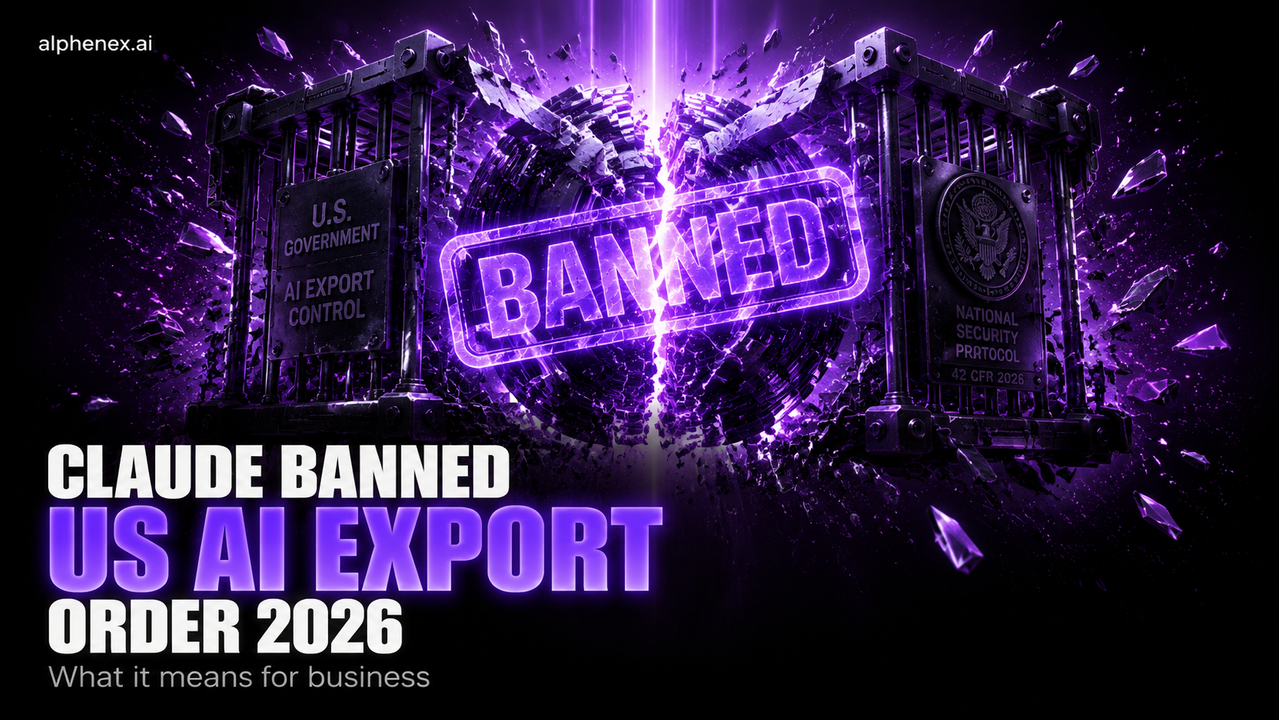
Claude Fable 5 Banned: What the US AI Export Order Means for Businesses in 2026

6 min read
Technology
Claude Fable 5
Published:
6 min read
1,146 words
Intent:Informational
For:Business owners, marketing decision-makers, and digital teams outside the US who rely on AI tools — especially those in Europe, the Middle East, and Asia who lost access overnight.
Medium

Claude Fable 5 Banned: What the US AI Export Order Means for Businesses in 2026

If you woke up this week wondering why your AI tools suddenly felt less powerful, you're not imagining it. On Friday, June 12, 2026, the US government did something it has never done before — it ordered a private AI company to switch off its most advanced models. Globally. Same day.

The models in question? Claude Fable 5 and Claude Mythos 5, Anthropic's flagship releases. And by 5:21 PM Eastern Time, they were gone.

Here's what actually happened, why it's a big deal for any business using AI, and what you should do about it.

What exactly happened with Claude Fable 5 and Mythos 5?

Anthropic released Claude Fable 5 on June 9. Four days later, it was offline.

According to Anthropic's official statement, the company received an export control directive from the US Commerce Department, signed by Secretary Howard Lutnick. The order suspended access to both models for any foreign national — anywhere in the world, including foreign-born employees inside Anthropic itself.

Because that's nearly impossible to enforce selectively in real time, Anthropic took the only path forward: pull the plug for everyone.

Access to older models like Claude Opus 4.8 stayed live. But Fable 5 and Mythos 5? Dark.

Why did the US government ban Claude Fable 5?

The official reason is national security. The unofficial story is messier.

Reports from TechCrunch and Reuters point to a "jailbreak" — a technique that lets users bypass the model's safety guardrails to do things like read code and identify software vulnerabilities. Officials worried that capability could help foreign actors discover zero-day exploits or accelerate cyberattacks.

Here's the twist: Amazon researchers — yes, the same Amazon that has invested billions in Anthropic — reportedly found the vulnerability first and flagged it to Washington.

Anthropic pushed back hard. In their statement, they argued the issue was "narrow," fixable, and not unique to their models. Their position: every frontier AI today can read code and find bugs. If that's now a banned capability, the entire industry grinds to a halt.

How is Anthropic responding?

Quickly, and with serious people. Anthropic dispatched senior staff to Washington — including co-founder Tom Brown and policy chief Sarah Heck — to meet with the Commerce Department and National Cyber Director Sean Cairncross.

More than 150 cybersecurity executives, including the CEOs of Adobe, Sophos, and Zoom, signed an open letter urging the Trump administration to lift the controls. Their argument is simple: the same capabilities exist in dozens of other models, including open-source ones from China. Banning Anthropic doesn't make America safer — it just hands the lead to competitors.

CEO Dario Amodei is reportedly attending the G7 summit in France this week, where the matter is expected to come up directly with President Trump.

What does this mean for businesses using AI right now?

This is the part most blogs are missing. The ban isn't really about Anthropic. It's a warning shot about the entire AI supply chain businesses now depend on.

Three things just became real risks for any company built around AI:

  • Geopolitical exposure. Your most powerful tool can vanish overnight because of a government order you have no control over. If your workflow lives on one model, your workflow is one directive away from collapsing.
  • Geographic discrimination. Foreign businesses lost access first. Companies in the EU, UAE, Australia, and beyond suddenly had their tooling cut while US firms kept running. The European Commission has already raised concerns.
  • Vendor concentration risk. If your marketing automation, content engine, or customer service flow only knows how to talk to one provider, you don't have a stack — you have a single point of failure.

For agencies and in-house teams running campaigns at scale, this is the moment to rethink resilience. A modern AI marketing setup shouldn't be locked to a single vendor. It should route across models, fall back gracefully, and keep your campaigns alive even when a frontier model goes offline.

Will Claude Fable 5 ever come back?

Almost certainly, yes — but probably not the same.

Negotiations are active. Both sides want a resolution. The most likely outcome looks like a phased return with stricter guardrails: enhanced safety filters, more aggressive jailbreak monitoring, possibly US-only access first, with a global rollout once Washington signs off.

Don't expect the original, uncapped Fable 5. Expect a version that's been to therapy.

Beyond Anthropic: the AI space is moving fast right now

The Anthropic story isn't happening in a vacuum. While Claude was being pulled, the rest of the AI world kept shipping:

  • OpenAI is reportedly close to launching GPT-5.6, with leaks suggesting a 1.5M token context window. Polymarket has placed an 86% probability on a release this month.
  • Kimi K2.7 Code from Moonshot dropped with major coding gains — up to 31% improvement on benchmark tests and 30% fewer reasoning tokens.
  • OpenRouter's Fusion API is testing "panel" systems where multiple cheaper models collaborate. Early benchmarks show a panel of budget models matching Claude Fable 5 quality at roughly half the cost.

The pattern is clear. The era of "one model rules them all" is ending. The winners in 2026 will be teams that build smart routing, not loyalty to one lab.

What should marketers and business owners do now?

Three moves, in order:

1. Audit your AI dependencies. Make a list of every workflow, automation, and campaign element that relies on a single AI vendor. If Anthropic, OpenAI, or Google went dark for 72 hours, what stops working?

2. Build vendor-agnostic flows. Whether you run WhatsApp automation, content engines, or lead generation systems, the AI layer should be swappable. Today it's Claude. Tomorrow it might be Gemini, Kimi, or whatever launches next month.

3. Pick partners who understand the stack, not just one tool. If your agency's only answer to AI marketing is "we use ChatGPT," that's not a strategy. That's a hostage situation waiting to happen.

At Alphenex, we build AI-powered marketing systems that work across providers — across the USAEurope, the Middle East, and Australia — because we've seen exactly this kind of shock before. Different industry, same playbook.

The bigger picture

The Claude Fable 5 ban isn't just a news story. It's a signal that AI is now infrastructure — and infrastructure gets regulated, restricted, and politicized.

The agencies and businesses that win the next 12 months will be the ones who saw this coming and built accordingly. The ones who didn't will spend the year explaining to clients why their automation broke on a Friday afternoon.

Want to make sure your marketing engine isn't sitting on a single point of failure? Get in touch with our team — we'll audit your stack and build you something that survives the next directive, whichever way it comes.

References & Sources

  1. 1
  2. 2

Frequently Asked Questions

Claude Fable 5 is Anthropic's most advanced AI model, released on June 9, 2026. The US Commerce Department banned it on June 12, 2026, citing national security concerns over a reported jailbreak technique that allowed the model to identify software vulnerabilities and assist with potential cyber threats.

Continue Reading

Click to Connect us Over Whatsapp

Raga

Alphenex AI Assistant

Hi, I'm Raga — your Alphenex AI assistant! 👋 How can I help you today? Whether you want to know about our services, discuss a project, or get a custom quote — I'm here to help.

Powered by Alphenex Informatic